
You walk into any supermarket in Sydney and you can purchase a chocolate bar for approximately $3.50. It will be consistent, shelf-stable, and recognisable. It will taste like chocolate — in the same way that instant coffee tastes like coffee. Now consider spending $15 on a handcrafted artisan chocolate bar from Billees. The difference is not merely price. It is an entirely different philosophy of production — and once you understand what goes into each, you will likely find the $3.50 bar difficult to justify.
This article is not an argument that everyone should only eat artisan chocolate. That would be pretentious and disconnected from reality. But if you have ever wondered what you are actually paying for when you spend more on craft chocolate, this is the breakdown you have been looking for. As someone who has spent years on both sides of the equation — studying the science of cacao, training in classical chocolate technique, and building a small Sydney-based chocolate business — I can tell you that the differences are real, measurable, and significant.
What “Handmade” Actually Means in Chocolate
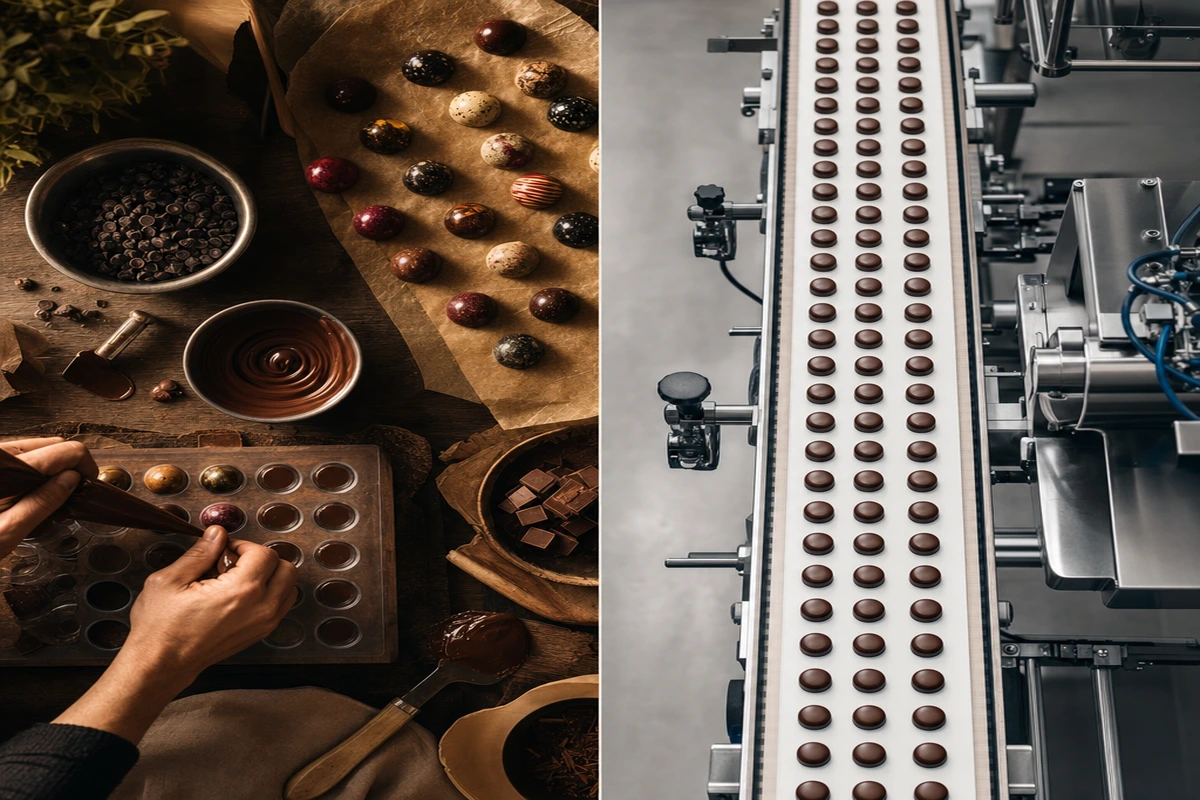
The term “handmade” in chocolate can mean different things depending on who is using it. At Billees, we take it literally: every piece of chocolate that leaves our Sydney workshop has been touched by human hands at multiple stages of production. This is not a marketing claim — it is a description of our process.
Hand tempering is perhaps the most important differentiator. Tempering is the process of carefully controlling the temperature of melted chocolate so that cocoa butter crystallises in the correct form — Form V crystals — giving chocolate its characteristic snap, gloss, and melt-in-the-mouth texture. Industrial producers use machines to temper chocolate continuously at massive scale. Artisan chocolatiers do it by hand, using marble slabs, inoculation techniques, and experienced judgment. The result is a chocolate that breaks cleanly, shines under light, and releases flavour beautifully on the palate. Machine-tempered chocolate can achieve a passable version of this, but the precision and tactile feedback of hand tempering produces superior results.
Handfinishing refers to the final decoration, enrobing, and presentation of each piece. At Billees, this includes hand-drizzling, hand-spraying cocoa butter finishes, placing inclusions by hand, and individually wrapping or boxing each item. In a factory, this entire process is automated on a production line. The personal attention means each piece is assessed for quality before it leaves the bench — not inspected after it has been sitting in a warehouse for eight months.
Small batch production is the structural difference that enables the other two. When you make chocolate in batches of 5kg rather than 5,000kg, you can actually pay attention to each batch. You notice when a roast profile is slightly off. You can adjust your tempering technique for the day's humidity. You catch problems before they become finished products. This is what we mean when we say quality over quantity — and it is the fundamental reason that handmade chocolate consistently outperforms mass-produced chocolate in blind taste tests.
The Mass-Production Process
To understand why artisan chocolate is different, it helps to understand how industrial chocolate is made. The mass-production process is a marvel of engineering efficiency — it is just optimised for entirely different goals than taste.
Industrial chocolate production begins with the selection of bulk cacao commodities — blended beans from multiple origins selected primarily for price stability and consistency, not flavour complexity. These beans are roasted at high temperatures in large drum roasters designed for throughput rather than precision. The nibs are ground and refined through steel ball mills, a process that can generate significant heat and affect flavour development. The resulting chocolate liquor is deodorised to remove undesirable notes — which unfortunately also removes many of the interesting ones.
The speed of production is the central trade-off. A mass-production facility may produce tens of thousands of bars per day. At that scale, hand tempering is impossible — machines use a process called Tabling, where molten chocolate flows over a cooled surface and is continuously scraped and recirculated to achieve crystallisation. This works, but it produces a different crystal structure than hand tempering on marble. The chocolate will set and be edible, but the snap will be less defined and the mouthfeel will be different.
Perhaps most importantly, mass-produced chocolate is designed for shelf stability across long supply chains. From the factory floor to a distribution warehouse to a supermarket backroom to the shelf and finally to your home, industrial chocolate must survive temperature fluctuations, prolonged storage, and delays at every stage. This means additives, stabilisers, and a composition that prioritises surviving neglect over delivering peak flavour. It is entirely possible — and indeed common — for a chocolate bar to sit in a warehouse for six to twelve months before it is purchased and consumed. Think about what that means for freshness.
Ingredient Quality: Where the Difference Starts
The ingredient panel of a chocolate bar tells you almost everything you need to know about what you are about to consume. Compare a mass-produced chocolate bar with a handcrafted artisan bar and the differences are stark.
Cocoa butter vs. palm oil and vegetable fats: Real chocolate is made with cocoa butter — the fat naturally present in the cacao bean. It is expensive and requires proper handling. Many mass-produced chocolate products replace some or all of the cocoa butter with palm oil, coconut oil, or other vegetable fats. These fats are cheaper, remain solid at room temperature, and extend shelf life significantly. They also do not taste like cocoa butter, do not temper the same way, and do not provide the same mouthfeel or melt characteristics. If palm oil or "vegetable oil" appears in the ingredients before cocoa butter, you are not eating real chocolate — you are eating a chocolate-flavoured confection.
Real vanilla vs. vanillin: Vanilla is one of the most expensive flavourings in the world — which is why mass producers use synthetic vanillin, a chemically identical compound that costs a fraction of the real thing. Vanillin provides a vanilla note but lacks the complex aromatic compounds found in real vanilla extract. At Billees, we use real vanilla — sometimes vanilla bean, sometimes quality vanilla extract — because it integrates into the chocolate differently and contributes to the overall flavour architecture rather than simply adding a single note.
Fresh cream vs. powdered milk: For milk chocolate, the quality of the dairy component matters significantly. Fresh cream contributes to a smoother, more luxurious texture and better flavour integration. Powdered milk is more stable and easier to handle in industrial processes, but it produces a flatter, less nuanced chocolate flavour. The difference is immediately apparent to anyone who tastes the two side by side.
Lecithin usage: Soy lecithin is an emulsifier used in chocolate to improve flow properties during manufacturing and reduce viscosity, allowing producers to use less cocoa butter (the expensive ingredient) while maintaining workable chocolate. A small amount of lecithin is not inherently problematic, but mass producers often use it aggressively to cut costs. Artisan producers typically use lecithin sparingly or not at all, relying on proper conching and processing techniques to achieve the desired texture. At Billees, we use minimal lecithin — only when a specific recipe genuinely benefits from it, never as a cost-reduction tool.
Flavour: The Most Obvious Difference
If you conducted a blind taste test between a high-quality artisan chocolate and a mass-produced bar, the flavour difference would be immediately apparent — even to someone who does not consider themselves a chocolate connoisseur.
Artisan chocolate, particularly single-origin or bean-to-bar chocolate, typically exhibits what flavour professionals call flavour complexity and layering. This means that as you eat a piece slowly, you experience different notes over time — perhaps an initial brightness of red fruit, followed by a mid-palate nuttiness, finishing with a clean, slightly bitter cocoa depth. This complexity comes from quality cacao, careful roasting that preserves rather than destroys aromatic compounds, and proper processing that does not strip the chocolate of its natural flavours.
Mass-produced chocolate, by contrast, tends to be what we call one-dimensional. The flavour is pleasant and recognisably chocolatey, but it does not evolve or develop. There is an initial sweetness, a cocoa note, and then it is done. This is not necessarily a flaw — it is an intentional product design. Mass-market chocolate is made to appeal to the broadest possible audience and to taste consistent batch after batch, year after year. Interesting and complex flavour is actually a liability in this context — it risks alienating some consumers. Uniform and predictable is the goal.
The other significant flavour factor is aftertaste. Quality artisan chocolate typically leaves a clean, pleasant finish — the cocoa butter coats the palate pleasantly and the flavour lingers without becoming cloying or waxy. Mass-produced chocolate often leaves a waxy, slightly artificial aftertaste that some people describe as a "chemical" or "artificial" sensation. This is the result of hydrogenated fats, artificial flavourings, and the waxy coating that mass producers add to improve shelf appearance.
For those in Sydney looking to experience this difference firsthand, our signature collection showcases a range of handcrafted chocolate pieces designed to demonstrate the breadth of flavour that artisan chocolate can achieve.
Freshness: Why It Matters
Freshness is perhaps the most underrated factor in chocolate quality — and the one where the difference between artisan and mass-produced is most stark.
Artisan chocolate, particularly from small producers like Billees, is often made to order or in very small batches that sell quickly. When you order a gift box or a selection of bonbons from an artisan chocolatier, there is a good chance those pieces were made within the previous week or two. The chocolate you receive is genuinely fresh — the cocoa butter is still within its optimal window, the textures are at their best, and the flavours are at their most vibrant.
Consider the supply chain of mass-produced chocolate. A bar manufactured in a facility in Melbourne might take two weeks to reach the distribution warehouse. It then spends anywhere from three to twelve months in that warehouse before being allocated to supermarkets. The supermarket then displays it on a shelf where it may sit for several more months. By the time you purchase and consume the bar, it could be twelve to eighteen months old from the point of manufacture. The chocolate is still technically edible — but it is not fresh. The cocoa butter has migrated, the flavour compounds have degraded, and the texture has changed. You are eating aged chocolate.
The difference in freshness is not just a theoretical concern — it has a measurable impact on taste and mouthfeel. Fresh artisan chocolate has a clean, bright snap when you break it. The shine is brilliant rather than dull. The melt in your mouth is smooth and immediate. Aged mass-produced chocolate can be dull in appearance, may have a sticky or soft snap, and often has a flavour that is present but muted — like stale bread compared to fresh.
At Billees, we design our products to be consumed at their best within three months of production. We do not add the preservatives that would allow our chocolate to sit on a shelf for a year. This is both a quality decision and an honest one — we want you to eat our chocolate when it tastes best, not when it has survived the longest.
The Australian Small Business Angle
There is a broader context to the artisan vs. mass-produced chocolate conversation that deserves attention: the economic and social value of supporting small Australian chocolate makers.
When you purchase a handcrafted chocolate bar from a small Australian producer like Billees, your money flows through the local economy in ways that a supermarket purchase simply cannot match. We employ Sydney-based chocolatiers and kitchen staff. We work with Australian suppliers for packaging materials, cardboard, and printing services. We engage Australian logistics and delivery partners. The multiplier effect of that spending stays in the community.
The chocolate industry globally is dominated by a handful of megaproducers — Cadbury, Mars, Hershey, Ferrero — that together control an enormous percentage of the world's chocolate production and sales. These are legitimate businesses that produce affordable chocolate for millions of people, and we do not dismiss the value of that. But the concentration of this industry means that the economic benefits of chocolate consumption flow primarily to shareholders of these large corporations, the majority of whom are based overseas. Small craft producers represent a meaningful counterbalance to that concentration.
Beyond economics, there is the question of craftsmanship and cultural value. Australia has a growing reputation for food craft — craft beer, artisan cheese, specialty coffee, handcrafted chocolate. These industries represent not just economic activity but cultural identity and pride. When you support a small Australian chocolate maker, you are supporting the development of a craft culture that enriches the country's culinary landscape. You are also preserving and developing skills and knowledge that cannot be automated or offshored.
Billees is proud to be part of this tradition. Our story is rooted in a belief that chocolate-making is both a science and an art — one that deserves the same respect and attention that we give to wine, cheese, and coffee. We are not trying to replace the chocolate aisle at the supermarket. We are offering an alternative for those who want something different.
When Mass-Produced Chocolate Is Fine
Let us be honest about something: there is absolutely a time and a place for mass-produced chocolate, and pretending otherwise would be dishonest.
Sometimes you just want a Tim Tam. Or a Moro. Or a Cherry Ripe. These are iconic Australian chocolate products that occupy a legitimate place in the national diet and culture — and we have no interest in diminishing that. The Tim Tam Slam is a genuinely enjoyable experience that has nothing to do with single-origin cacao or hand tempering. Mass-produced chocolate has a role to play in casual snacking, baking, cooking, and those moments when you need something sweet and familiar without ceremony or expense.
The point of this article is not to make anyone feel guilty for enjoying supermarket chocolate. It is to provide information so that you can make an informed choice. If you understand what you are buying — and what you are not buying — then no harm, no foul. The problem is when people spend money on artisan chocolate expecting it to be a better version of the same product, rather than a fundamentally different product with different goals. That mismatch creates disappointment on both sides.
Artisan chocolate is for when you want to experience something exceptional. For gifting someone you care about. For marking a special occasion. For the pure pleasure of tasting something made with care and intention. For those moments, we believe the extra cost is not just justified but obvious.
But if you are making chocolate chip cookies, baking a birthday cake, or satisfying a late-night chocolate craving at 9pm on a Tuesday — the supermarket bar is entirely appropriate. We make no apologies for that. We simply ask that when you do choose to spend more on craft chocolate, you understand what you are paying for and why.